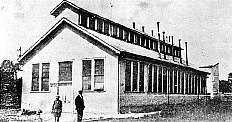
Dudlo Manufacturing Co. started the magnet wire industry in Fort Wayne in this 50-by-100-foot building on Wall Street in 1914.
By LYNNE McKENNA FRAZIER of The News-Sentinel
The company George A. Jacobs founded in 1914 is long defunct. But the industry he founded is still vital.
Jacobs founded the magnet wire industry in Fort Wayne with the start of Dudlo Manufacturing Co. He revolutionized the infant electrical industry by developing an enamel insulation for wire, making wire much less bulky, easier to wind and more efficient.
Winding the wire creates a magnetic field that makes electric motors turn. Early in the century, electrical motors were being used in infant industries such as appliances, autos and industrial machinery.
The industry had ready customers close at hand -- General Electric Co.'s growing operation on Broadway and the burgeoning auto industry sprouting around Detroit. Delco-Remy and Ford Motor Co. became major Dudlo customers.
On the eve of the Depression, Dudlo merged with three other companies to form General Cable Corp. The company proved vulnerable when the U.S. economy slid into deep recession, and in 1930 it closed its Fort Wayne offices. The company, which once employed 6,000, ceased manufacturing in Fort Wayne in 1933.
Although the founding company was gone, the magnet wire industry was growing -- all with ties to Dudlo. That was in the days before non-compete clauses in contracts with key employees.
Jacobs himself founded the first spin-off, Inca Manufacturing, after he left General Cable in 1929. Inca was sold to Phelps Dodge Corp. in 1931, forming the basis of the magnet wire unit based here.
In 1933, Victor Rea, a former Dudlo superintendent, also quit General Cable to start Rea Magnet Wire Co. The privately held company still operates on East Pontiac Street.
And in 1936, Essex Co. bought the former Dudlo plant. The company moved its headquarters from Detroit to Fort Wayne 30 years later. Recently merged with Superior TeleCom Inc., the company still makes magnet wire in Fort Wayne and Kendallville, as well as building wire in Columbia City.
Those are the big three in magnet wire. But the industry also spawned a host of die makers and related support companies, several of which still thrive.
Employment Manager of Company Will Enroll Employes for the New Plant.
STARTS WORK AT ONCE
Employment Foster, of the Dudlo Manufacturing company, is spending the afternoon at New Haven enrolling employes for the branch which will start operation Wednesday, March 17, according to the present arrangements of the company. Mr. Foster will be at the New Haven State bank all of next week for the purpose of selecting girls and a few men for work at New Haven.
The speed with which the branch is being opened, after final negotiations for the building had been completed, indicates that the company is in great need for immediate expansion, which the management states has been occasioned by the enormous demands on the production of the plant. The inability of the company to secure the help that has been needed has been a drawback and the recent step taken by the company has been with a view to overcome this difficulty.
The extent to which the New Haven plant will be enlarged has not been determined, but for the present from 50 to 100 girls will be employed and if company sees fi for further expansion at that place there, may be a great many more employed. Only recently a new two-story building has been added to the local plant and now another building is being constructed.
History of the Dudlo Manufacturing Company - Bates, Roy M 1965 Archive.org. “made Fort Wayne the magnet capital of the world”. George A. Jacobs, its owner, was a native of Dudley, Mass. and, in 1906, a “promising figure at Sherwin Williams”. As the market for the automobile was growing, existing wire was not capable of performing the job needed to help spark and fire engine components. The wire was too thick and the veneer cracked and peeled too easily. Jacobs worked for three years and finally came up with a “liquid mixture which made obsolete the tedious process of winding fine wire with cotton fabric…..The Old Fort News article “Wire Wizards” in the 1970 Vol. 33 No. 1 edition gives a more detailed description of the origins of magnet wire for those who are interested. From the Model T to Spacecraft from The History Center Blog Posted by Nancy McCammon-Hansen August 7, 2012.
Magnet wire is a copper or aluminum wire coated with a very thin layer of insulation. An improved method for making magnet wire was developed in Fort Wayne, an innovation that fostered local industries to such an extent that Fort Wayne became known as the magnet wire capital of the world. Without magnet wire, electrical devices, such as motors, television, computers, and automobiles would not be possible. George Jacobs formed the Dudlo Wire Company in 1911 with William Mossman and his son, B. Paul Mossman. He perfected a chemical enameling that had been a large problem for General Electric and other companies; the insulating process allowed wire of any thickness—especially fine wire—to be coated evenly with a chemical insulation that could be baked on and yet remain flexible enough to be wrapped into coils. It was a great improvement on the former process of wrapping wire with fabric. This process was used by Dudlo through World War I and into the 1920s. Several other local magnet wire manufacturers were formed out of Dudlo, including Rea Magnet Wire and INCA (later Phelps Dodge). Superior Essex later acquired the company plant and for a time Superior Essex, Rea Magnet Wire, Phelps Dodge and General Electric in Fort Wayne were producing ninety percent of the magnet wire in the United States. Though several of these companies have left Fort Wayne, two of the largest producers of Magnet Wire in the United States, Rea Magnet Wire and Superior Essex are still headquartered in our community. Stay tuned for Thursday’s Socially History post as we take a look at items from our collection that use magnet wire. To learn more about these companies and magnet wire, visit the History Center’s Allen County Innovation Exhibit. #sociallyhistory
Fort Wayne has a unique history of innovation stretching back to its founding. It's incredible, and sometimes missed,...
Fort Wayne has a unique history of innovation stretching back to its founding. It's incredible, and sometimes missed, that some of that history is captured in the homes throughout our historic neighborhoods. Today is one of those stories, starting with the very foundation of the United States magnet wire industry.
The story begins today on Fairfield, at the corner of Pontiac and the entrance of Beechwood. The home that was once there was originally built in 1919 by John Stillman, with Charles Weatherhogg designing it. During the 1920s and 1930s, though, George Jacobs lived there with his family. The home seated prominently next to one of the most storied homes of the time, the Noll Mansion. George, though, was the main reason Fort Wayne became known as the magnet wire capital of the world.
Like many Fort Wayne innovators, George was brought here to work as a chemist in the GE plant. It was there he met the love of his life, Ethel Mossman. George was born in Dudley, Massachusetts, and found another opportunity with Sherwin Williams in Cleveland while at GE. During these years, George worked day and night to solve a technical but common problem at the time; wire in the early 1900s was incapable of sparking and firing engine components.
Now, you can imagine in the early 1900s, with the automobile being developed, this was a considerable problem. The solution was creating a liquid mixture that made a former process (winding wire with cotton fabric) obsolete and acted as an insulation for the wire. Excitement for what he created spurred George to ask Ethel to be his wife finally. Ethel's father, W.E. Mossman, wishing his family to be nearby, enticed George to return to Fort Wayne by offering him a building for his fledgling company, the Dudlo Company.
The Dudlo Company became a significant supplier for Ford, efforts in World War I, and pretty much any company needing this newly developed magnet wire. The business peaked in the late 1920s, merging with others to create a Fort Wayne headquartered magnet wire powerhouse. Jacobs, unhappy with the new company, started INCA, which eventually became Phelps Dodge, Jacobs' protégé, Victor Rea, started Rea Magnet Wire, and Essex purchased the old Dudlo manufacturing space.
These three companies provide 2/3 of the world's magnet wire, all thanks to the man on Fairfield. While the home is no longer there, I hope you enjoy some of the pictures. I want to thank Nathan Bienz, Kristy Michelle, True Fort Wayne Indiana History, and The History Center for the photos and information.
Picture 1: Home at Fairfield and Pontiac
Picture 2: Dudlo Manufacturing
Picture 3: George Jacobs
Picture 4: Noll Mansion (far left Jacobs' home in picture)